By [Author Name], BBC/Variety Correspondent
1. The Final Goodbye
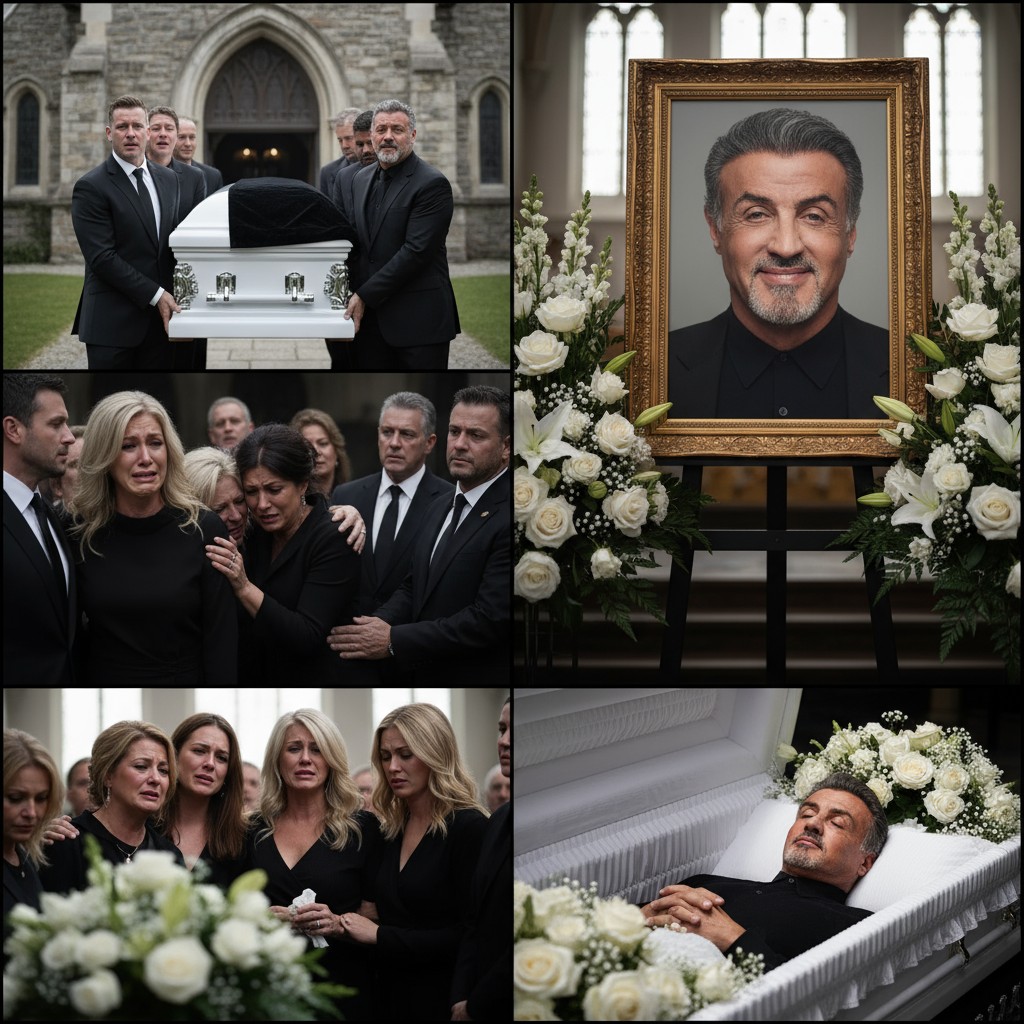
The world of cinema stands still tonight. A somber shadow falls across Hollywood as news breaks that Sylvester Stallone, the indomitable icon of grit, resilience, and cinematic heroism, has passed away peacefully at the age of 79. His family confirmed the heartbreaking news early this morning, surrounded by quiet mourning and reverence for a man who embodied strength both on and off the screen.
According to sources close to the family, Stallone’s final moments were marked by a profound calm. His last ten words—whispered to his wife, Jennifer Flavin, and to the fans who had stood by him for over five decades—were said to be:
“Keep fighting. Love your family. Never give up on hope.”
Simple, yet deeply emblematic of the spirit that defined his life.
Across social media, tributes flood timelines, not with sensationalism, but with heartfelt gratitude. Fans recall the first time they saw Rocky sprinting up the steps of the Philadelphia Museum of Art. Others remember Rambo’s weary eyes, a soldier’s burden made human. To millions, Stallone wasn’t just an actor—he was a symbol of the ordinary person’s extraordinary fight.
2. A Life Written in Sweat and Triumph
Born in Hell’s Kitchen, New York, in 1946, Sylvester Gardenzio Stallone’s rise to global fame was nothing short of cinematic destiny. His beginnings were humble—his speech slightly slurred due to nerve damage at birth, his early career littered with rejection letters and closed doors. Yet, in that struggle, Stallone found his story.
In 1976, he sat down at a small desk and wrote Rocky—a screenplay that would not only change his life but redefine Hollywood’s understanding of the American Dream. Refusing to sell the script unless he could star in it himself, Stallone took a gamble that would echo for generations. Rocky went on to win three Academy Awards, including Best Picture, and cemented Stallone as both an actor and a writer with a rare, unyielding spirit.
From Rambo to Creed, from Cobra to The Expendables, Stallone crafted characters that were larger than life yet painfully human—men defined not by perfection, but by persistence. His films often portrayed the bruised dignity of the underdog, the weary courage of a man standing alone against impossible odds.
Through it all, Stallone remained fiercely loyal to his roots, often reminding interviewers that every punch thrown on screen was a tribute to those who fought in silence in their own lives.
3. Behind the Legend: A Man of Family, Faith, and Quiet Strength
Away from the cameras, Stallone was not the archetype of the Hollywood star; he was a husband, a father, and a deeply introspective man. His marriage to Jennifer Flavin, which endured public scrutiny and private trials, was described by friends as “a love built on friendship, forgiveness, and faith.” Together, they raised three daughters—Sophia, Sistine, and Scarlet—whom Stallone often credited as his greatest achievements.
Those close to him say that in recent years, Stallone became reflective, even spiritual. “He talked often about legacy,” a family friend shared. “Not the kind measured in box office numbers, but in how you loved, how you forgave, how you showed up for people.”
In his home, filled with old movie posters and family photos, Stallone kept a handwritten note taped to his study wall. It read:
“The fight isn’t about winning. It’s about never quitting.”
4. The Illness He Faced with Courage
In the past year, reports began circulating quietly that Stallone had been battling a degenerative cardiac condition, one that gradually weakened his health but not his will. Those close to him said he chose privacy over publicity, focusing his final months on family and reflection.
Friends described how he continued to write, sketch, and even train lightly in his home gym. “He never wanted pity,” one longtime friend said. “He said if people remembered him, it should be for how he lived, not how he left.”
Stallone’s final public appearance came earlier this year at a private charity gala in Los Angeles. Though visibly frailer, he smiled warmly and delivered a brief message to the crowd:
“Life’s not about how hard you hit—it’s about how you get back up.”
Words he first wrote for Rocky Balboa, but which, in retrospect, sound like a farewell letter to the world.
5. Hollywood and the World React
As the news spread, tributes poured in from every corner of the globe. Actor Arnold Schwarzenegger, Stallone’s longtime friend and friendly rival, wrote:
“Sly, you were my brother in arms, on screen and in life. No one fought harder, loved deeper, or inspired more.”
Filmmaker James Gunn called him “a titan of storytelling whose humanity made his heroes immortal.”
Former co-star Michael B. Jordan, who played Adonis Creed in the Creed series, shared a tearful post:
“You taught me what it means to fight with heart, to believe even when the world doubts you. Thank you for every lesson, every word, every moment.”
Fans have begun gathering at the Rocky Steps in Philadelphia, leaving flowers, boxing gloves, and handwritten notes. Across the world, cinemas plan to screen Rocky and First Blood in his honor, transforming the weekend into a global vigil of gratitude.
6. A Legacy Beyond the Screen
Stallone’s contribution to cinema extends beyond his legendary roles. He was a screenwriter, director, painter, and philanthropist, dedicating much of his later life to causes supporting veterans, underprivileged youth, and heart disease research.
He once said in an interview, “Every person has a little bit of Rocky inside them.” Perhaps that’s why his loss feels so personal. His characters reflected universal struggles—of doubt, redemption, resilience. He gave people permission to fall, and then to rise again.
Cultural historians often point to Rocky as a defining film of post-Vietnam America—a story that united audiences through shared vulnerability and hope. Decades later, Creed reintroduced his message to a new generation: that strength is not about domination, but about endurance.
His art transcended cinema; it became part of the human story.
7. A Call for Compassion and Reflection
As with any public figure’s passing, media coverage has surged. Yet amid the noise, Stallone’s family has appealed for privacy and grace.
“He gave the world his soul through his work,” the family’s statement read. “Now, we ask the world to let him rest with peace and dignity.”
Ethical journalism reminds us that behind every icon lies a human being—a father, a husband, a friend. Stallone’s life was a testament to vulnerability wrapped in muscle, emotion hidden behind grit. Reporting his death is not just about documenting loss, but about honoring life.
Hollywood, so often enamored with glamour, finds itself reflecting on something far more profound: the quiet courage it takes to face one’s own mortality with love and gratitude.
8. The Final Bell
Tonight, lights across Los Angeles dim as movie studios pay tribute to the man who taught the world what it meant to fight from the heart. The statue of Rocky Balboa in Philadelphia—once a prop, now a monument—has become a beacon for mourning fans. Candles flicker at its base, and somewhere, a young dreamer watches Rocky for the first time, whispering the same words that carried Stallone through life: “Keep moving forward.”
Sylvester Stallone’s story was never just about boxing, war, or explosions. It was about human endurance—about finding meaning in pain, family in the face of fame, and faith in the fight itself.
And so, as Hollywood says goodbye, it also says thank you—to the man who taught generations to rise after every fall.
“Keep fighting. Love your family. Never give up on hope.”
Those were his final ten words.
And they will echo, forever, in every heart that dares to believe.