The 25th Amendment talk is back.
Lawmakers have repeatedly floated the method for removing a president, as laid out in the Constitution, in recent years. And Donald Trump’s Cabinet apparently discussed the option more earnestly than many initially realized after the January 6, 2021, Capitol attack.
To successfully remove Trump, a majority of his Cabinet and his vice president would have to be supportive. And there are no indications any Cabinet officials are considering it right now, or that Vice President JD Vance would be on board. But Trump’s comment Tuesday morning that a “whole civilization will die tonight” unless Iran makes a deal spurred increasing calls — among a somewhat odd amalgamation of voices — to invoke the amendment.
Less than two hours before his 8 p.m. deadline for Iran, Trump announced he’d agreed to a two-week ceasefire, conditional on Tehran opening the Strait of Hormuz.
Democratic lawmakers and right-wing voices had spent the previous 24 hours expressing concerns about just how far the president was willing to take things in the Iran war. His threats to strike power plants and other civilian infrastructure have been decried as war crimes, and some even said they feared the administration’s threats alluded to the potential use of nuclear weapons (which the White House has denied considering).
It’s mostly Democrats who have called to invoke the amendment — dozens of them, in fact. That includes potential presidential hopefuls like Illinois Gov. J.B. Pritzker. (Of course, they have little to no power at the moment to initiate removal proceedings.)
But notably, some conservatives and other recent Trump allies have taken up the call, as well.
“How do we 25th Amendment his ass?” conspiracy theorist Alex Jones asked his guest on Monday’s show.
By Tuesday morning, right-leaning advocates for the step spanned from more-extreme influencers to former Trump White House official Anthony Scaramucci to more-moderate Never Trumpers.
“25TH AMENDMENT!!!” former congresswoman Marjorie Taylor Greene, a Georgia Republican, posted on X about an hour after Trump’s post about Iran’s civilization dying. She called it “evil and madness.”
Some congressional Democrats re-posted Greene’s words.
“The 25th amendment needs to be invoked,” right-wing podcaster Candace Owens added later in the morning.
Scaramucci, who served briefly as Trump’s communications director during his first term, advocated for Trump’s removal and claimed Trump was threatening to use nukes.
“Wake up: he is calling for A NUCLEAR STRIKE,” Scaramucci said. “Seek his removal immediately.”
When others suggested online that Vance had implied Tuesday morning that Trump could order a nuclear strike, the White House denied he was saying anything of the sort. The vice president had talked about using “tools in our toolkit that we so far haven’t decided to use.”
Some Never Trump conservatives like New York Times columnist David French were also calling for the 25th Amendment.
“This is obvious 25th Amendment territory, but people are so desensitized that they can’t see it,” French said.
Others didn’t go quite so far, but have begun raising new levels of concern about Trump’s intentions.
One of them is former Trump ally Tucker Carlson, who on his show Monday criticized Trump like never before. The former Fox News host said Trump was threatening to commit “a war crime, a moral crime” in Iran by attacking infrastructure in ways that would lead to mass death, and he even seemed to suggest Trump might be the antichrist.
Also on Tuesday, GOP Sen. Ron Johnson of Wisconsin, who has been a loyal Trump ally in Congress, told the Wall Street Journal that Trump “loses me if he attacks civilian targets” like infrastructure. Johnson signaled he saw such attacks as indeed illegal.
None of it means the 25th Amendment is around the corner. The option is difficult to invoke, requiring those closest to Trump to determine he is unfit for office and opt to remove him against his will. Vance happened to be in Hungary on Tuesday, and he called Trump on the phone so the president could address a political rally.
But it’s significant even as a brushback pitch from some erstwhile Trump allies and from Democrats. They seem to be saying that Trump had better think carefully about his next actions in the war.
It’s also worth reflecting on where things stand now.
When this was floated in Trump’s first term, it was almost universally the domain of Democrats. When some in his Cabinet apparently considered it after January 6, they did so quietly. The public didn’t find out until much later how seriously they’d been weighing it.
Today, even some recent former Trump allies have apparently been so fearful of what he might do that they’re publicly calling to oust him.
This story has been updated with additional developments.
President Donald Trump bulldozed yet another longstanding norm of American government on Wednesday by becoming the first modern president to attend an oral argument of the Supreme Court.
It’s no real secret what this was about.
Presidents have avoided attending oral arguments to negate even the appearance of trying to unduly influence a coequal branch of government. But Trump is happy to browbeat whomever it takes to get what he wants. And he’s reserved some of his most pointed recent criticisms for Supreme Court justices he appointed who have occasionally ruled against him.
So after spending two years floating breaking this norm — and after suffering his biggest Supreme Court defeat in the chamber’s February tariffs decision — Trump finally did it.
But his decision to go was curious. And it’s arguably even more so after the hearing.
Trump seemed to want to send a signal to judges, who have increasingly proven his biggest obstacles in his second term. The fact that he chose to attend even amid the war with Iran — and hours ahead of a primetime address to the nation on the conflict — would seem to reinforce that. It’s not like he doesn’t have other things to do.
But combined with a series of adverse recent court rulings, his presence at the Supreme Court risked reinforcing how little he can control the judicial branch.
The policy at issue on Wednesday was Trump’s executive order on birthright citizenship. On the president’s first day back in office last year, he sought to effectively overturn the more-than-century-old interpretation that the 14th Amendment grants citizenship to the children born to noncitizens on US soil.
The conventional wisdom has long been that this order stood little chance of surviving the courts — it’s been ruled against at every turn in the lower courts — and Wednesday’s hearing did little to disabuse anyone of that notion.
Solicitor General D. John Sauer faced a barrage of skeptical questions even from the court’s conservative and Trump-appointed justices.
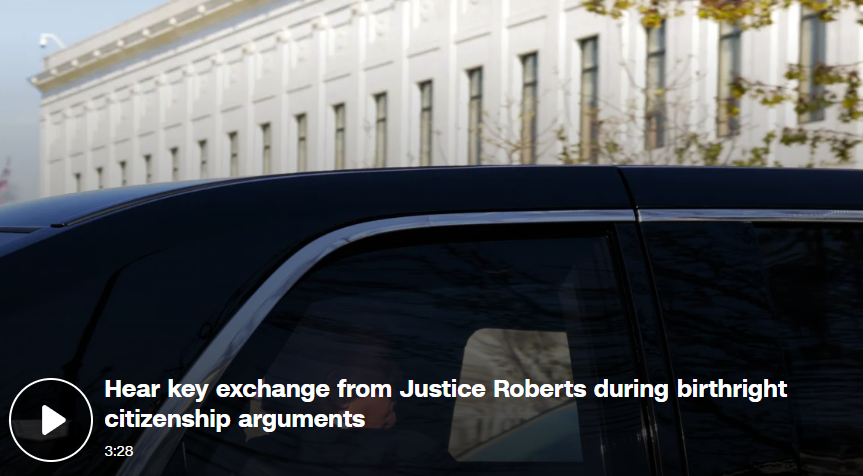
In perhaps the most difficult exchange for the administration, Chief Justice John Roberts pressed Sauer on its claims about so-called “birth tourism,” or traveling to US soil to deliver a child so they can be a citizen. When Roberts noted that wasn’t a problem when the 14th Amendment was ratified after the Civil War, Sauer responded that “we’re in a new world now.”
To which Roberts shot back: “Well, it’s a new world. It’s the same Constitution.”
Trump left the hearing shortly after Sauer wrapped up and as the justices began questioning ACLU national legal director Cecillia Wang.
We’ll likely have to wait until June or July to hear what the court rules. But based on the arguments, it seems possible the decision could be even more lopsided than Trump’s 6-3 defeat in the tariffs case.
It would even seem possible, judging by Justice Brett Kavanaugh’s questions, that all three Trump appointees could rule against him.
An outcome like that from the first case in which Trump decided to show up in person could prove that he doesn’t have the influence he seemed to want to show.
And to be clear, Trump has made no secret that he wants these justices to feel the pressure.
He savaged Kavanaugh in 2021 for occasionally ruling against him despite Trump having stood by his nominee during an arduous confirmation process in 2018.
Trump has also frequently attacked Justice Amy Coney Barrett as she has emerged as a tough vote for him. And after the tariffs decision in February, Trump said both Barrett and Justice Neil Gorsuch were an “embarrassment to their families.”
But it’s not just Wednesday’s tough hearing that painted an increasingly unfriendly picture for Trump’s efforts to bend judges to his will. He chose to do this at a particularly inauspicious time.
Over the last few weeks, a series of rulings have gone against him on some high-profile issues:
A judge overturned his administration’s efforts to effectively shutter the Voice of America.
Another overturned his Defense Department’s restrictive press policy that wound up excluding virtually every mainstream outlet.
Then a judge halted his administration’s sanctioning of Anthropic after Anthropic refused to let the Pentagon do what it wanted with its AI technology. The judge called the Pentagon’s move “Orwellian.”
And on Tuesday alone, judges both overturned Trump’s order ending NPR and PBS funding and halted Trump’s efforts to build a new ballroom on the White House grounds — which might be one of Trump’s most prized initiatives right now.
None of these cases are over. But they add to an increasingly ugly picture of how Trump’s policies have fared in court. (Because the courts take a while to act, that picture has come into focus slowly.)
Trump seems to think he can manipulate judges much like he does Republicans in Congress. Most GOP lawmakers, after all, strain to avoid alienating Trump’s base for fear of hurting their chances in a primary.
But judges are different animals. They not only have lifetime appointments, but they actually value the appearance of independence. It’s an asset, even something to be cultivated and emphasized.
Trump lamented that independence in remarks at an Easter lunch after returning to the White House from the Supreme Court.
“Republican judges and justices, they always want to show they’re independent,” he said in a video posted by a Business Insider reporter who said the White House had uploaded it to its YouTube page. (The video was no longer visible on the page as of early Wednesday evening.)
Trump went on to describe how he thinks those judges behave. “‘I don’t care if Trump appointed me. I don’t care if … he doesn’t make any difference to me. I’m voting against him,’ because they want to show their independence.”
But it’s quite possible that Trump’s show of force could have the opposite effect. It could make the justices — and other judges — feel more like they have to stand up for their branch of government, lest it look like Trump is controlling them to some extent.
That doesn’t mean judges aren’t susceptible to pressure. But the calculus is different. And Trump doesn’t seem to have an answer for the fast-accumulating list of cases in which judges — and even many GOP- and Trump-appointed ones — have ruled against his brazen power grabs.
So he tried something different on Wednesday. He might wish he hadn’t.
This story has been updated with comments from President Donald Trump.