
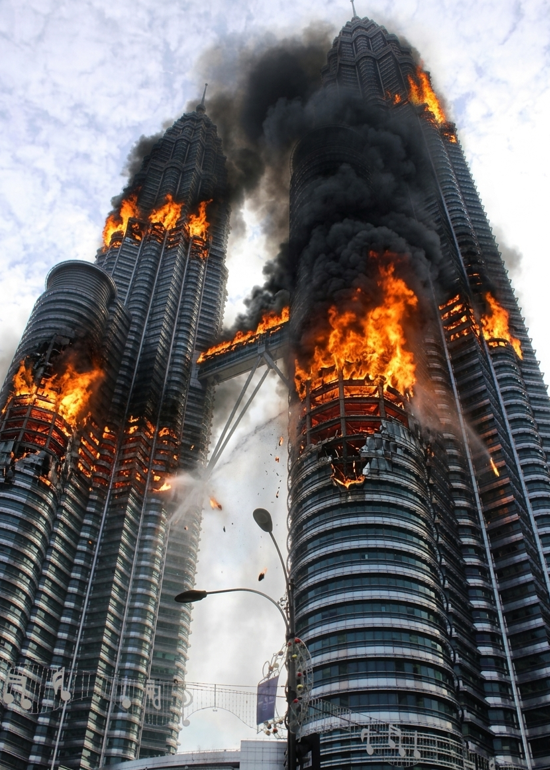
RIGH NOW!!! High Rise Building caught fire for unknown reasons, trapping 20 people inside…See more
The first signs were almost beautiful.
Against the bruised twilight skyline, where glass towers shimmered like vertical oceans reflecting the final amber streaks of sunset, a thin ribbon of smoke curled upward into the night air. At first, it looked harmless—an industrial sigh drifting lazily between steel and concrete. Pedestrians paused only briefly. Drivers slowed at intersections. A few people raised their phones, assuming they were witnessing another minor urban disturbance in a city that had long ago normalized chaos as background noise.
Then the windows exploded.
Flames erupted from the upper floors of the high-rise like a living force suddenly released from captivity. Orange fire rolled outward in violent bursts, devouring curtains, office partitions, wiring, insulation, and oxygen itself. Glass shattered across the streets below in glittering cascades. Sirens screamed through the avenues. Somewhere above the twentieth floor, silhouettes appeared against the inferno—human figures pounding desperately on sealed windows, waving shirts, flashlights, anything visible enough to signal they were still alive.
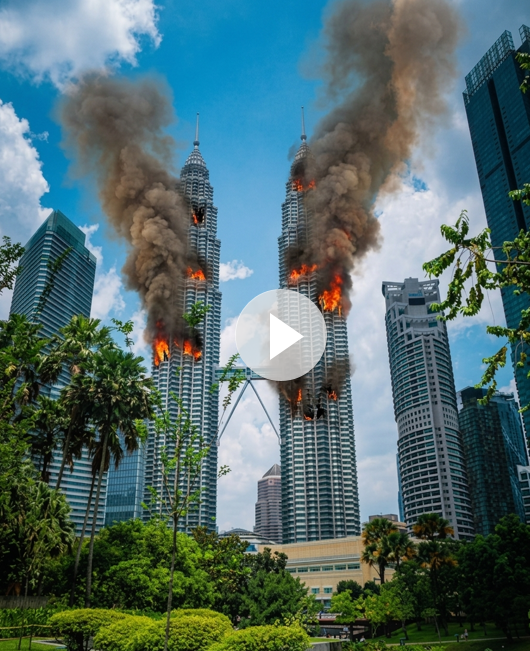
Within minutes, the building transformed from a symbol of modern ambition into a vertical trap.
Preliminary reports implied that at least 20 people remained stranded inside as the fire intensified. Emergency operators were overwhelmed with calls. Social media feeds erupted with grainy livestreams and frantic eyewitness accounts. Helicopters circled overhead, their spotlights cutting through columns of black smoke rising into the atmosphere like volcanic ash.
And beneath the growing panic hung the most terrifying detail of all: nobody yet understood why it had happened.
The Anatomy of a Catastrophe
The tower itself represented the modern urban dream—high-density efficiency wrapped in mirrored sophistication. Rising dozens of stories above the surrounding district, it housed a blend of luxury apartments, corporate offices, and retail spaces, a common architectural hybrid in rapidly expanding global cities where land scarcity drives vertical living.
Yet these towering structures, engineered to embody progress, also contain hidden vulnerabilities few residents fully comprehend.
According to early emergency dispatch communications, the fire may have originated somewhere in the building’s mid-level mechanical infrastructure before spreading upward through ventilation shafts and service corridors. Experts suggest that in modern skyscrapers, fires rarely behave like the contained room blazes depicted in films. Instead, they exploit the very systems designed to make tall buildings livable.
Air circulation networks become highways for smoke. Electrical conduits transmit heat between floors. Pressure differences inside stairwells can create what engineers call the “stack effect,” a phenomenon in which rising hot air accelerates combustion vertically with frightening speed.
What unfolded inside the tower was not merely a fire—it was a complex thermodynamic event.
As temperatures surged past several hundred degrees Celsius, materials that seemed inert during normal conditions likely began releasing toxic gases. Synthetic carpeting, foam insulation, plastic cabling, adhesives, and composite furniture can produce lethal smoke long before flames physically reach occupants. Fire investigators consistently note that in modern high-rise incidents, smoke inhalation—not direct burns—causes the majority of fatalities.
Witnesses described seeing people trapped near upper-floor windows where smoke had already darkened entire sections of the structure. Some reportedly used phone flashlights to signal rescuers. Others pressed clothing against vents or crouched low near the floor in attempts to avoid inhaling superheated fumes.
Meanwhile, firefighters entering the structure faced a battle governed by physics as much as courage.
Water pressure decreases with elevation. Elevators become unusable or dangerous. Visibility collapses rapidly. Temperatures inside sealed corridors can exceed survivable thresholds within minutes. Every floor represents another layer of uncertainty, another maze of collapsing materials, another pocket of trapped civilians waiting in darkness.
Fire in the Vertical Age
Urban historians often describe skyscrapers as monuments to humanity’s refusal to remain earthbound. Since the late nineteenth century, the race upward has defined economic power, architectural prestige, and national identity. Cities compete through skylines the way ancient kingdoms once competed through cathedrals.
But every generation of tall buildings has also produced disasters that forced civilization to confront uncomfortable truths.
The modern history of fire safety in high-rises is written in tragedy.
From catastrophic hotel fires in the twentieth century to apartment tower infernos that shocked global audiences in recent years, nearly every major urban fire disaster has revealed a painful pattern: technological advancement frequently outpaces regulatory adaptation. Safety systems considered sufficient during construction can become dangerously outdated within decades. Maintenance shortcuts accumulate invisibly. Human complacency grows in proportion to architectural confidence.
In many rapidly developing metropolitan centers, high-rise construction has accelerated at astonishing speed. Entire districts emerge within years, often under immense economic pressure. Experts in urban infrastructure warn that while design aesthetics and occupancy demands evolve rapidly, safety enforcement mechanisms sometimes lag behind.
Preliminary reports imply investigators are examining whether suppression systems inside the tower functioned properly during the earliest stages of the incident. Questions are also likely to focus on evacuation procedures, emergency stairwell accessibility, alarm responsiveness, and compartmentalization systems intended to slow fire spread between floors.
These technical details may sound bureaucratic, even mundane. Yet history shows they determine whether people survive.
A functioning fire door can mean the difference between containment and catastrophe. A pressurized stairwell can become a lifeline instead of a chimney. A delayed alarm by even several minutes can trap hundreds.
In the aftermath of disasters, cities often discover that the greatest dangers were neither dramatic nor mysterious. They were ordinary failures ignored for too long.
Inside the Psychology of Panic
As flames climbed the tower, another force spread almost as rapidly through the surrounding city: collective fear.
Crowds gathered behind police barricades, staring upward in stunned silence punctuated by screams whenever flames burst through another level. Families desperately attempted to contact loved ones believed to be inside. Emergency hotlines became saturated. Hospitals activated mass-casualty protocols. Journalists relayed fragmented updates in real time while millions online attempted to piece together events through unstable livestreams and unverified posts.
Psychologists who study disaster behavior note that high-rise fires trigger a uniquely primal form of terror.
Unlike earthquakes or storms, fires are visibly alive. They move. They consume. They transform familiar environments into hostile terrain with horrifying speed. In skyscrapers especially, the fear becomes existential because escape itself feels abstract. Human beings evolved to flee danger horizontally across open land—not descend dozens of smoke-filled floors while enclosed within collapsing vertical structures.
Survivors of major tower fires often describe a profound distortion of time. Seconds feel stretched. Sounds become fragmented. Rational thought narrows into instinctive calculations: Which stairwell is usable? Is the smoke getting thicker? Should I stay or run? Is the door handle too hot to touch?
Even those outside the building experience psychological shock through identification. Watching people trapped at impossible heights forces viewers into a deeply unsettling confrontation with vulnerability. Towers symbolize security, wealth, permanence, and engineering mastery. Seeing them burn destabilizes the illusion of control modern cities depend upon.
And in the digital era, that destabilization spreads globally within minutes.
The Information Inferno
Almost immediately after footage emerged online, speculation exploded across social media platforms.
Some posts claimed explosions had occurred prior to the fire. Others alleged electrical failures, gas leaks, construction defects, or even deliberate sabotage. Videos were reposted without verification. Images from unrelated incidents began circulating alongside authentic footage. Artificial intelligence-generated visuals appeared within hours, blurring the line between documentation and fabrication.
Emergency communication experts warn that misinformation during unfolding disasters creates secondary hazards capable of undermining rescue operations themselves.
False casualty numbers trigger unnecessary panic. Incorrect evacuation rumors can redirect families away from official assistance centers. Misidentified victims cause emotional trauma. Speculative accusations interfere with investigations before evidence can be gathered.
Authorities urged the public to rely on confirmed emergency updates, though in crises of this scale, information ecosystems rarely remain orderly for long.
There is also a darker sociological dimension to modern disaster coverage. Catastrophe has become algorithmically amplified. The most emotionally charged images travel fastest. Flames framed against skylines become instant symbols consumed by global audiences often detached from the human reality inside them.
Some viewers experience genuine empathy. Others consume the spectacle passively, almost cinematically, scrolling between tragedy and entertainment within the same digital feed.
This transformation of disaster into content raises uncomfortable ethical questions about how modern societies process suffering. Are viral images increasing awareness—or numbing collective sensitivity through repetition?
The answer may be both.
Engineering Under Siege
Behind the dramatic visuals lies an intensely technical battle unfolding floor by floor.
Firefighters confronting skyscraper blazes operate within one of the most dangerous environments in emergency response. Traditional firefighting methods become exponentially more complicated as altitude increases. Hose deployment requires immense coordination. Internal communication systems can fail amid heat and structural interference. Thermal imaging visibility deteriorates through dense smoke and reflective surfaces.
Structural engineers monitoring the incident are likely evaluating several simultaneous risks.
Steel, contrary to popular belief, does not need to melt to become dangerous. At elevated temperatures, it weakens significantly, potentially compromising load-bearing integrity. Reinforced concrete may spall violently when trapped moisture converts to steam under extreme heat. Curtain-wall glass systems can fail unpredictably, raining debris onto evacuation zones below.
Experts suggest that if the fire penetrated mechanical floors or utility cores, suppression efforts could become dramatically more difficult. These central infrastructure zones function as the nervous system of a skyscraper, carrying electrical lines, water systems, communications cables, and ventilation networks vertically throughout the structure.
Modern fire engineering relies heavily on compartmentalization—the principle that fires should be isolated long enough for evacuation and suppression. But when barriers fail, high-rise fires can evolve into dynamic systems driven by airflow, fuel load, and heat transfer in ways difficult to predict in real time.
Every minute becomes a contest between containment and escalation.
The Human Stories Emerging from Smoke
As rescue operations continued, fragments of personal stories began surfacing from witnesses, survivors, and first responders.
A maintenance worker reportedly helped guide residents toward emergency stairwells before becoming trapped himself. Office employees described navigating corridors blackened by smoke while emergency alarms echoed through the building. One witness claimed to have seen strangers carrying elderly occupants down staircases in near-total darkness.
Disasters often expose the duality of human nature with startling clarity.
Fear can trigger selfishness, confusion, paralysis. Yet it can also produce astonishing acts of courage from ordinary people with no training, no equipment, and no obligation beyond instinctive compassion.
Firefighters ascending smoke-filled stairwells understand that every upward step moves against the direction everyone else is fleeing. Medics entering unstable environments accept risks invisible to the crowds filming from below. Building staff who remain behind to assist evacuations frequently do so knowing they may not escape themselves.
These moments rarely dominate headlines for long. Investigations, political debates, and infrastructure analyses eventually take center stage. But within the immediate violence of catastrophe, survival often depends less on systems than on individual decisions made under impossible pressure.
Cities of Glass and Fragility
The burning tower also reflects a broader paradox of twenty-first-century urban civilization.
Modern cities are marvels of interconnected systems so advanced they appear almost frictionless during ordinary life. Electricity arrives invisibly. Elevators transport thousands effortlessly. Climate-controlled interiors separate residents from weather, noise, and even geography itself.
Yet this seamless convenience masks immense complexity.
A single electrical fault, failed suppression valve, overheated transformer, or compromised material can cascade through an entire structure with astonishing speed. Dense urban environments amplify consequences because vertical populations compress thousands of lives into concentrated spaces.
Architects and engineers increasingly warn that climate pressures may further complicate high-rise fire risks in coming decades. Rising temperatures strain electrical grids. Extreme heat events increase cooling demands. Urban density intensifies infrastructure stress. New construction materials, while efficient and lightweight, sometimes introduce combustion characteristics not fully understood under catastrophic conditions.
Experts suggest future skyscraper design may evolve toward more adaptive fire-resistant systems integrating artificial intelligence, real-time thermal monitoring, autonomous suppression technologies, and enhanced evacuation modeling.
But innovation often follows tragedy rather than preventing it.
The Long Shadow After the Flames
Even after the fire is extinguished, the disaster’s true timeline will only begin.
Investigators will comb through charred corridors searching for ignition points. Structural assessments may take weeks. Survivors could face years of psychological recovery. Families awaiting confirmation of missing relatives will endure agonizing uncertainty measured not in hours, but in official statements, forensic examinations, and unanswered phone calls.
Economic consequences will ripple outward as businesses suspend operations, insurance claims multiply, and regulatory scrutiny intensifies. Political leaders may promise reforms. Developers may defend existing standards. Advocacy groups will likely demand accountability.
Meanwhile, residents across the city may suddenly reevaluate their own buildings with fresh anxiety. Fire exits once ignored become objects of scrutiny. Smoke alarms sound more ominous. Elevator rides feel subtly different.
Disasters alter perception long after debris is cleared.
For many people watching the tower burn, the event shattered an unconscious belief that modern infrastructure guarantees safety. It reminded the public that technological sophistication does not eliminate vulnerability—it merely changes its form.
The skyscraper, humanity’s ultimate declaration of urban confidence, remains fundamentally dependent on fragile systems maintained by imperfect institutions and imperfect people.
A Final Glimpse Through the Smoke
Near midnight, long after darkness swallowed the skyline, the fire still glowed from within the tower like a furnace hidden behind broken glass. Water streams arced upward from the streets below, illuminated briefly by emergency lights flashing red and blue against drifting smoke clouds.
Somewhere inside, firefighters continued moving through heat and debris searching for survivors floor by floor. Outside, families waited behind barricades clutching phones, hoping for messages that might never come. The city itself seemed suspended in a strange collective stillness, listening to the distant hiss of water against burning steel.
In moments like these, catastrophe strips away the illusion that civilization is stable simply because it is tall, illuminated, and technologically advanced.
Human beings build upward because we believe height represents triumph over limitation. Towers symbolize aspiration, permanence, dominance over gravity and nature itself. Yet fire remains one of the oldest reminders that no structure—regardless of wealth, engineering, or prestige—is ever fully immune to chaos.
Perhaps that is why images of burning skyscrapers resonate so deeply across cultures and generations. They confront us with an uncomfortable contradiction at the heart of modern life: the same ambition that allows humanity to create breathtaking cities also creates increasingly complex systems vulnerable to sudden collapse.
And so, as smoke drifts across the skyline and investigators begin searching for answers hidden somewhere inside the scorched skeleton of the tower, the world watches not only a fire, but a reflection of itself.
A civilization reaching ever higher into the sky, still struggling to master the flames below.