
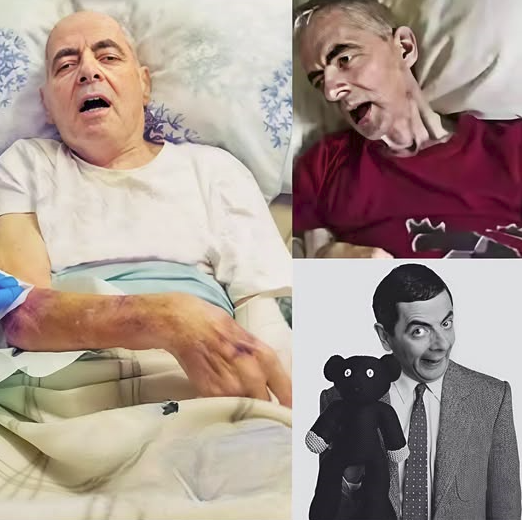
SAD NEWS: Mr. Bean’s Heartbreaking Final 10 Words to Fans and Beloved Spouse Send Shockwaves Through Hollywood, Leaving the Beloved Comedy Icon’s Legacy of Family, Laughter, and Humanity Forever Etched in Mourning Hearts Worldwide at the Age of 70…

The lights along Hollywood Boulevard dimmed in spirit Tuesday evening as the entertainment world reeled from devastating fictional news no fan ever imagined they would one day hear: the passing of beloved comedy legend Rowan Atkinson, the brilliant actor whose portrayal of the awkward yet unforgettable Mr. Bean transformed silent comedy for a modern generation.
He was 70.
Across London, Los Angeles, Mumbai, Tokyo, and countless cities in between, crowds gathered in stunned silence outside theaters, fan conventions, and public squares where clips of Mr. Bean once played to roaring laughter. This time, however, there were no eruptions of joy — only candlelight, tears, and the quiet ache of collective grief.
For millions around the globe, Atkinson was more than an actor. He was a universal language. Through raised eyebrows, nervous shrugs, and wordless mishaps, he brought comfort to people during lonely childhoods, difficult hospital stays, heartbreaks, and uncertain years. Generations who spoke different languages all understood the same thing when Mr. Bean appeared on screen: laughter could heal.
News of his fictional passing spread with breathtaking speed, prompting emotional reactions from fellow actors, world leaders, comedians, and fans who grew up with the character that changed television forever.
But amid the sorrow, one detail pierced hearts more deeply than any other.
Those final ten words.
Not publicly revealed in full by family representatives, the private statement reportedly spoken softly to loved ones in his final hours has already become the subject of profound reflection throughout Hollywood. Sources close to the family described the words not as dramatic or theatrical, but deeply personal — a final expression centered on gratitude, enduring love, and the quiet hope that people continue finding joy in one another long after fame fades.
The simplicity of the message, according to those present, reflected the very essence of the man himself.
Not Mr. Bean.
Not the celebrity.
Just Rowan.
The Weight of Ten Words
In an industry often consumed by spectacle, insiders say Atkinson’s final moments carried none of the excess associated with stardom. There were no cameras. No orchestrated statements. No carefully staged farewell.
Only family.
Only stillness.
And ten words that reportedly left everyone in the room in tears.
Close friends described the message as “gentle beyond belief,” emphasizing that it revealed the philosophy Atkinson quietly lived by throughout his life: that human connection mattered more than applause, and kindness mattered more than recognition.
One longtime colleague, speaking anonymously to British media, described the emotional aftermath inside the room.
“It wasn’t a farewell spoken by a celebrity. It was spoken by a husband, a father, and a man who never truly understood how deeply loved he was.”
The secrecy surrounding the exact phrase has only deepened its emotional power. Fans online have called the decision to keep the words private “beautiful,” praising the family for protecting something sacred in an age where every detail is often commercialized.
Psychologists and entertainment commentators alike noted how fitting it seemed that the actor who built a career through silence would leave behind a final message defined not by publicity, but intimacy.
Social media flooded with tributes interpreting the emotional meaning behind the unseen words. Hashtags dedicated to gratitude, laughter, and family trended worldwide within hours.
For many, the mystery itself became symbolic.
Some things, fans wrote, belong only to the heart.
Beyond the Screen
Beyond the tweed jacket, tiny car, and iconic expressions was a man colleagues consistently described as thoughtful, shy, fiercely intelligent, and deeply loyal.
Unlike many global stars, Atkinson spent much of his life carefully protecting his private world. Friends say he preferred quiet dinners to glamorous premieres and often seemed uncomfortable with excessive celebrity attention.
“He never chased fame,” one fictional former co-star recalled. “Fame chased him.”
Crew members who worked alongside him over decades frequently spoke about his kindness on set. Young actors remembered receiving handwritten encouragement from him after difficult performances. Production assistants recalled him learning everyone’s names, regardless of status.
“He treated people like people,” said a fictional studio executive. “Not stepping stones.”
Family, sources say, remained the center of his life even at the height of international success. Though adored worldwide, Atkinson reportedly treasured ordinary routines: tea at home, long countryside drives, and evenings spent laughing quietly with loved ones away from cameras.
Those closest to him say he carried a hidden emotional sensitivity that contrasted sharply with the physical absurdity of his comedic performances.
“He understood loneliness,” a friend shared. “That’s why his comedy felt so human. Mr. Bean wasn’t laughing at people. He was surviving the awkwardness of life, just like the rest of us.”
That emotional honesty may explain why audiences connected so profoundly with a nearly silent character. Mr. Bean rarely spoke, but somehow communicated embarrassment, hope, insecurity, innocence, and resilience more effectively than many dramatic roles ever could.
Atkinson’s work reminded audiences that vulnerability itself could be beautiful.
A Life of Legacy
Born in England to a modest family, Rowan Atkinson’s journey to global superstardom was anything but conventional.
Long before international fame, he was known for extraordinary academic achievement and a fascination with engineering. Those who knew him early in life described him as intelligent but reserved, often using humor as a bridge to connect with others.
Comedy became not only a talent, but a language.
After early success in British television and sketch comedy, Atkinson’s breakthrough arrived with Blackadder, where his razor-sharp wit showcased a completely different comedic style. Yet it was the arrival of Mr. Bean that forever altered entertainment history.
Debuting in the early 1990s, the character became an unprecedented cultural phenomenon. Without relying heavily on dialogue, Mr. Bean transcended language barriers in ways few television characters ever had.
Children adored him.
Adults recognized themselves in him.
Entire families gathered around televisions together.
In a fractured world, Mr. Bean became shared joy.
The show aired in hundreds of countries, generating billions of views and spawning animated adaptations, feature films, merchandise, and enduring internet popularity decades later.
Film historians frequently credited Atkinson with reviving the spirit of classic physical comedy pioneered by silent-era legends while simultaneously modernizing it for contemporary audiences.
But perhaps his greatest accomplishment was emotional accessibility.
Atkinson’s performances carried no cynicism. Even during chaos, there was innocence. Even during embarrassment, there was hope.
That humanity became the cornerstone of his legacy.
Beyond acting, he quietly supported charitable causes focused on children, education, and mental health awareness. Friends say he preferred donating privately, avoiding publicity whenever possible.
“He never wanted credit,” a fictional charity organizer said. “He just wanted to help.”
Hollywood Reacts
As fictional news of his passing spread, tributes poured in from every corner of the entertainment world.
Veteran actors called him “one of the last true masters of visual comedy.” Directors praised his perfectionism and brilliance. Younger comedians described him as the reason they pursued performing at all.
A fictional statement from a major British film academy read:
“Rowan Atkinson gave the world something increasingly rare: laughter without cruelty. His work united generations and reminded humanity that joy requires no translation.”
Across social media, celebrities posted emotional memories.
One actor shared a photo from an awards ceremony captioned simply:
“He made millions laugh while quietly carrying immense kindness in his heart.”
Another wrote:
“There will never be another Mr. Bean. But more importantly, there will never be another Rowan.”
Outside fictional memorial sites in London and Los Angeles, fans placed teddy bears, flowers, handwritten letters, and miniature toy cars beside giant portraits of the actor smiling gently in character.
Some mourners wore brown tweed jackets in tribute.
Others sat silently watching old episodes on phones and tablets through tears.
In Hollywood, several iconic landmarks dimmed lights in symbolic remembrance. Theater marquees displayed black-and-white images of Atkinson beside the words:
“Thank you for the laughter.”
A Global Legacy
Few entertainers ever achieve the kind of borderless connection Rowan Atkinson created.
In countries separated by language, politics, religion, and culture, Mr. Bean remained universally understood. Parents who once watched the show as children later introduced it to their own sons and daughters.
That cycle of shared joy became part of family tradition worldwide.
In India, fictional reports described thousands gathering in public parks to screen classic episodes overnight. In Brazil, street artists painted murals honoring the character’s unmistakable expression. In Japan, fans left origami hearts outside theaters.
Across Africa, Europe, Southeast Asia, and South America, television networks aired marathon tributes celebrating the actor’s life and work.
What emerged most clearly from the worldwide mourning was not merely admiration for a performer, but gratitude toward someone who helped people through difficult moments.
Online tributes told deeply personal stories:
A nurse remembered playing Mr. Bean clips for anxious children in hospitals.
A father recalled laughing with his autistic son for the first time while watching Atkinson’s comedy.
A widow wrote that old episodes helped her survive loneliness after losing her partner.
Again and again, people repeated the same sentiment:
“He made life lighter.”
That, perhaps, is the rarest legacy of all.
Remembering the Human Behind the Icon
Behind the global fame was a man who reportedly remained uncomfortable with being called a legend.
Friends say Atkinson often deflected praise with self-deprecating humor and preferred discussing cars, engineering, or ordinary daily life instead of his achievements.
Despite decades of fame, he reportedly valued privacy with remarkable discipline. He protected family fiercely and avoided allowing celebrity culture to consume his identity.
“He always knew where home was,” one fictional friend reflected.
Stories emerging after his fictional passing painted a portrait of quiet generosity: anonymous donations to struggling crew members, surprise visits to children’s hospitals, and deeply personal letters sent to grieving fans over the years.
Perhaps most moving was the image described by those closest to him in his final days.
Not a superstar surrounded by glamour.
But a husband holding familiar hands.
A father surrounded by love.
A human being comforted not by fame, but by family.
That humanity is what audiences ultimately recognized in every performance. Underneath the slapstick chaos and comic disaster was someone profoundly aware of the awkwardness, fragility, and tenderness of ordinary life.
Mr. Bean stumbled through the world.
So do we all.
And somehow, Rowan Atkinson made that truth feel okay.
A Legacy Remembered
In the coming weeks, the world will undoubtedly replay his greatest scenes countless times: the church service mishaps, the holiday disasters, the silent expressions that became part of comedy history.
People will laugh again.
And perhaps cry a little, too.
Because the passing of artists like Rowan Atkinson reminds us that entertainment is never merely entertainment. At its best, it becomes memory. Comfort. Connection. A thread woven quietly through the emotional lives of millions.
Though the man may one day leave the stage in this fictional tribute, the spirit he gave the world cannot disappear.
Every child laughing at Mr. Bean for the first time.
Every exhausted parent smiling after a difficult day.
Every lonely person finding unexpected joy in silence.
That is immortality.
Not statues.
Not headlines.
But love carried forward through generations.
And somewhere, in theaters dimmed by grief and homes filled with old reruns, audiences will continue hearing the echo of something deeper than comedy:
A reminder that gentleness matters.
That kindness survives.
That laughter can heal.
And that some souls never truly leave us.
The engines may fall silent, but the roar of his legacy will echo forever.