
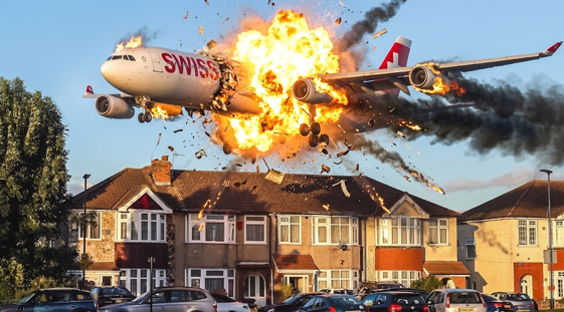
SWISS A-10 MILITARY AIRCRAFT ERUPTS IN FLAMES OVER THE ALPS: TEN DEAD, TWENTY INJURED IN ONE OF EUROPE’S MOST SHOCKING AVIATION DISASTERS IN YEARS
Introduction Summary
The sky above central Switzerland was cloudless on the morning of September 18, 2025, when witnesses in the alpine canton of Obwalden looked up to see what many first believed was an air show maneuver gone horribly wrong. A low-flying military aircraft — later identified by authorities as an upgraded A-10 attack aircraft operated under a joint NATO training exchange program — was trailing thick black smoke before erupting into flames mid-air. Seconds later, debris rained across a wooded mountainside near the village of Engelberg.
Within hours, the Swiss Federal Department of Defence confirmed the deaths of ten people, including crew members and military personnel onboard. Twenty others on the ground and in nearby structures were injured, several critically, after burning wreckage slammed into a tourist lodge and ignited a secondary fire near a mountain transit station.
The incident rapidly evolved from a local emergency into a multinational investigation involving Swiss aviation authorities, NATO technical teams, American aerospace specialists, and European military safety agencies. Early evidence suggested that a catastrophic engine failure may have triggered an onboard fire while the aircraft was conducting a low-altitude tactical navigation exercise through alpine corridors frequently used in joint training missions.
As helicopters circled above smoking pine forests and rescue workers searched for remains in steep terrain, disturbing questions emerged. Why was a heavily armed military aircraft flying so close to civilian areas? Had warning signs been ignored? And how had a platform originally designed during the Cold War ended up at the center of one of the deadliest aviation disasters in modern Swiss history?
What followed was a story of technical failure, institutional pressure, human courage, and a nation grappling with a tragedy it never expected to witness.
What Happened
At approximately 10:42 a.m. local time, air traffic control operators at Meiringen Air Base lost stable telemetry from an A-10 Thunderbolt II aircraft participating in Exercise Alpine Shield, a multinational military readiness drill involving Swiss, German, Italian, and American personnel.
The aircraft had departed from a NATO logistics facility in northern Italy earlier that morning and entered Swiss airspace under a pre-approved bilateral defense cooperation arrangement. Officials later stated the aircraft was carrying no live munitions but did contain a full internal fuel load and several inert training pods.
Residents near Engelberg reported hearing what sounded like “multiple explosions” echoing through the mountains. Video recorded by hikers on nearby Titlis trails captured the aircraft banking sharply left while emitting a stream of fire from the rear fuselage. In the footage, flames appeared concentrated around the starboard engine nacelle before rapidly engulfing the tail section.
Seconds later, the aircraft descended uncontrollably behind a ridge line. A massive orange fireball erupted from the forest below.
Emergency dispatch centers were overwhelmed with calls.
According to Swiss rescue officials, debris spread across nearly two square kilometers of mountainous terrain. Large sections of the aircraft crashed into dense woodland while smaller fragments struck nearby buildings, including the Edelweiss Panorama Lodge, a family-owned tourist property occupied by hikers and seasonal workers.
The impact triggered a fast-moving fire fueled by aviation fuel and dry alpine vegetation. Thick smoke could be seen from more than 30 kilometers away.
Authorities initially feared the death toll could exceed thirty.
Military helicopters from the Swiss Air Force, along with civilian rescue teams, reached the area within twenty-five minutes. But terrain, heat, and continuing explosions from onboard oxygen systems complicated operations.
By nightfall, officials confirmed ten fatalities and twenty injuries. Several victims suffered severe burns and blunt-force trauma caused by falling debris.
The disaster immediately dominated headlines across Europe.
Timeline of Events
Investigators later reconstructed the aircraft’s final minutes using cockpit audio fragments, radar data, eyewitness footage, and telemetry logs.
At 10:17 a.m., the aircraft entered Swiss airspace near Lugano under standard military transit clearance. Pilots reportedly communicated normally with controllers and began a scheduled low-altitude navigation sequence through designated alpine corridors.
At 10:34 a.m., maintenance monitoring systems recorded abnormal exhaust temperature readings in the right engine. Investigators later revealed that onboard diagnostics showed intermittent fluctuations in oil pressure approximately eight minutes before the crash.
Pilots acknowledged a “minor systems irregularity” but did not immediately declare an emergency.
At 10:39 a.m., witnesses near Lake Lungern heard a loud metallic bang. Aviation analysts later suggested this may have been a turbine blade failure — a catastrophic event capable of shredding internal engine components at extremely high speed.
Within moments, the aircraft began trailing smoke.
Cockpit communications released days later indicated growing panic inside the aircraft.
“We’ve got fire indication starboard side… attempting reroute,” one crew member reportedly transmitted.
Air traffic control instructed the pilots to divert toward Meiringen Air Base, one of Switzerland’s principal military aviation facilities. But the aircraft was already losing altitude rapidly.
At 10:41 a.m., a second explosion occurred.
Investigators believe fragments from the damaged engine may have punctured fuel lines near the rear fuselage, igniting a larger fire that spread into hydraulic control systems.
The aircraft became increasingly unstable.
Radar records showed erratic altitude changes moments before contact was lost completely.
At 10:42 a.m., the aircraft disappeared behind alpine terrain and crashed.
The first emergency calls reached police dispatchers less than forty seconds later.
Victims, Survivors, and Eyewitnesses
Among the dead were four military personnel onboard the aircraft and six civilians on the ground, including lodge employees and tourists caught in the blast zone.
One of the victims, 32-year-old Clara Meier of Lucerne, had been working at the Edelweiss Panorama Lodge during the autumn hiking season. Her husband later told reporters she had called him moments before the crash after hearing military aircraft overhead.
“She said it sounded unusually low,” he recalled. “Then the line just went silent.”
Another victim, German tourist Matthias Keller, was hiking with friends near a scenic overlook when debris struck the trail area. One survivor described seeing “burning metal falling from the sky like meteors.”
Twenty-three-year-old Sofia Bianchi from Milan suffered severe burns while attempting to help trapped visitors escape the burning lodge.
“I remember the smell first,” she told Italian television from a hospital bed in Zurich. “Then screaming. Everything was orange and black.”
Emergency responders described scenes of chaos rarely witnessed in Switzerland’s tightly controlled aviation environment.
Paramedic Alain Vogel said rescuers initially struggled to determine whether unexploded military components remained active.
“There was fire everywhere,” he explained. “Trees were exploding from heat. Fuel was running downhill through the forest. People were injured in multiple locations.”
Local residents also became unexpected first responders.
Farmers used tractors to move debris blocking narrow access roads while volunteer firefighters formed water relay lines from mountain streams.
One resident, 61-year-old Emil Gasser, helped evacuate injured hikers despite suffering smoke inhalation himself.
“You don’t think,” he later said quietly. “You just hear people crying.”
Investigation Details
Within hours, the Swiss Transportation Safety Investigation Board established a restricted zone around the impact site. Military analysts from the United States Air Force and NATO aviation command arrived in Switzerland the following day.
Attention quickly centered on the aircraft’s right engine assembly.
Preliminary forensic analysis suggested a catastrophic uncontained engine failure — one of the most feared emergencies in aviation. Unlike contained failures, where engine casings absorb internal damage, uncontained failures can eject high-speed metal fragments capable of severing fuel lines, hydraulic systems, or flight controls.
Investigators recovered charred turbine fragments nearly 800 meters from the main wreckage field.
A senior investigator familiar with the inquiry stated that metallurgical analysis revealed signs of “advanced fatigue cracking” inside critical rotating components.
The findings intensified scrutiny over the aging A-10 platform itself.
Originally developed in the 1970s for anti-armor warfare, the A-10 Thunderbolt II — nicknamed the “Warthog” — was never designed for modern alpine tactical training environments involving densely populated civilian corridors.
Although upgraded repeatedly, the aircraft’s aging structure has long been debated within defense circles.
Internal NATO maintenance records later leaked to several European newspapers allegedly showed concerns about component fatigue in older engine systems used during multinational exercises.
Swiss authorities refused to confirm the authenticity of the documents but acknowledged investigators were examining maintenance history “very closely.”
Another key focus involved emergency decision-making.
Why had the crew continued the flight after initial warning indicators appeared? Could the aircraft have diverted earlier? And were risk assessments for low-altitude training missions sufficiently robust?
Investigators also examined whether weather conditions and terrain amplified the disaster. Alpine valleys can create dangerous airflow patterns and leave pilots with little recovery time during mechanical emergencies.
Data from the aircraft’s flight recorder revealed the crew attempted to steer away from populated areas in the final seconds before impact.
Swiss Defense Minister Karin Baumann later stated that “the pilots’ final actions likely prevented substantially greater civilian casualties.”
Official Reactions
The Swiss government declared a national day of mourning three days after the crash.
Flags flew at half-staff across federal buildings while church bells rang in several cantons at noon.
Speaking before parliament in Bern, President Lukas Aeschlimann called the disaster “a moment of profound national grief.”
“Our mountains witnessed unimaginable horror,” he said. “We mourn the dead, stand beside the injured, and demand complete answers.”
NATO Secretary General Elise van Doren expressed condolences and pledged full cooperation with Swiss investigators.
Meanwhile, the United States Department of Defense dispatched technical specialists from the Air Force Safety Center to assist with engine analysis and aircraft systems reconstruction.
Public pressure intensified after Swiss media revealed that residents in the Engelberg region had previously complained about increasing military flight activity connected to multinational exercises.
Opposition lawmakers demanded temporary suspension of all foreign military low-altitude flights through Swiss mountain corridors until the investigation concluded.
Defense officials resisted calls for a blanket ban but announced an immediate review of joint exercise procedures.
International Media and Public Response
The disaster dominated European broadcasts for days.
Images of flaming wreckage scattered across pristine alpine forests stunned audiences worldwide. Social media platforms filled with videos captured by hikers, motorists, and residents who watched the aircraft descend in flames.
Major international outlets compared the tragedy to previous military aviation disasters involving aging Cold War-era platforms still operating in modern environments.
Public debate quickly expanded beyond Switzerland.
In Germany, Italy, and France, commentators questioned whether Europe’s increasing military coordination efforts were outpacing safety infrastructure.
Online aviation communities dissected cockpit audio, flight paths, and maintenance histories frame by frame.
Meanwhile, misinformation spread rapidly.
False rumors claiming the aircraft carried live missiles or radioactive material circulated widely before authorities firmly denied them.
Conspiracy theories also emerged alleging sabotage, cyber interference, or classified cargo onboard the aircraft. Swiss federal police stated there was “no evidence whatsoever” supporting criminal interference at that stage of the investigation.
Still, distrust lingered among some residents living near military training routes.
In Engelberg, candlelight vigils transformed into emotional public forums where grieving families demanded accountability.
“We are not a testing ground,” one resident shouted during a televised town meeting. “People died because someone decided this risk was acceptable.”
Broader Context and History
Switzerland has historically maintained strict control over its airspace despite its military neutrality. However, growing security cooperation with NATO partners in recent years has increased the frequency of multinational aviation exercises crossing central European regions.
Exercise Alpine Shield was intended to improve interoperability between allied forces operating in mountainous terrain — a strategic concern following renewed geopolitical tensions across Europe.
Critics now argue the exercise exposed vulnerabilities in balancing military readiness with civilian safety.
The A-10 aircraft itself has long occupied a controversial place in defense policy debates. Revered by many pilots for its survivability and battlefield effectiveness, the aircraft has also faced repeated criticism over age-related structural issues and rising maintenance costs.
Several previous incidents involving engine malfunctions, wing fatigue, and landing gear failures had been documented internationally over the past decade, though few resulted in mass casualties.
Military analysts note that operating older aircraft in challenging environments dramatically increases technical stress.
“Mountain flying is unforgiving,” said retired British aviation investigator Martin Ellery. “You have altitude changes, wind shear, narrow escape corridors, and minimal recovery windows. A manageable engine problem over flat terrain can become catastrophic in seconds over the Alps.”
Environmental concerns also emerged after the crash.
Swiss ecological agencies warned that aviation fuel and chemical residue from the wreckage contaminated nearby streams and alpine soil systems. Cleanup operations were expected to continue for months due to difficult terrain and fragmented debris distribution.
Tourism businesses in the region suffered immediate cancellations as images of burning forests circulated internationally.
For many locals, the tragedy shattered a sense of alpine security long associated with Switzerland’s mountain communities.
Lingering Questions
Months after the crash, critical questions remained unanswered.
Investigators continued examining whether maintenance inspections had missed warning signs hidden deep within engine assemblies. Aviation unions questioned whether operational pressure during multinational exercises discouraged pilots from declaring emergencies early.
Families of victims demanded transparency regarding prior technical concerns involving the aircraft type.
Why had aging aircraft continued flying through populated alpine routes? Were financial considerations prioritized over modernization? And had civilian risk assessments been properly communicated to local communities?
The crash also reopened broader debates about military aviation accountability in Europe.
As geopolitical tensions increase, joint exercises have become larger and more frequent. Yet critics warn that aging fleets, logistical strain, and compressed readiness schedules may create hidden systemic dangers.
Some experts fear the Swiss disaster may represent not an isolated accident, but a warning sign.
Final Emotional Conclusion
By the time winter snow began covering the scarred mountainside near Engelberg, much of the wreckage had been removed. Burned trees stood blackened against white alpine slopes. Temporary memorials — candles, photographs, handwritten letters — remained near security barriers overlooking the crash zone.
For Switzerland, the disaster became more than an aviation accident.
It exposed the fragile intersection between military preparedness and civilian life, between technological confidence and mechanical reality. In a nation known for precision, stability, and safety, the sight of a military aircraft falling from the sky shattered assumptions many believed unbreakable.
Families continue waiting for final investigative findings. Survivors still undergo surgeries and rehabilitation. Local residents still describe hearing the explosions echo through the valleys.
And despite months of analysis, technical reports, and political statements, one haunting truth remains impossible to ignore:
Ten people boarded or encountered what should have been an ordinary day in the Swiss Alps — and never came home.
The mountains have gone quiet again. Tourists have slowly returned. Trains once more climb through green valleys beneath towering peaks.
But in Engelberg, many residents say the silence feels different now.
Every distant aircraft sound carries a memory. Every low rumble overhead triggers instinctive fear.
Because for forty catastrophic seconds on a clear September morning, the sky itself seemed to catch fire.