

RIGHT NOW!!! Taipei 101 building catches fire, 20 d.e.a.d.

1. Dramatic Opening Scene: The Sky That Suddenly Turned Against Itself
The night over Taipei had begun like any other—dense with neon reflections, humid air rising from the streets, and the constant pulse of a city that rarely sleeps. Then, without warning, the skyline changed its character. High above the urban sprawl, at the upper tiers of one of the world’s most recognizable skyscrapers—Taipei 101—a faint glow appeared, almost delicate at first, like a distant ember caught in glass.
Within minutes, that glow became something far less forgiving.
Witnesses on the ground described a surreal transformation: the tower’s pristine silhouette, once a symbol of engineered calm and vertical ambition, began to flicker with violent orange pulses. The fire did not behave like something grounded in ordinary physics; it seemed suspended in the sky, crawling along the building’s exterior like a living organism testing the limits of steel and glass.
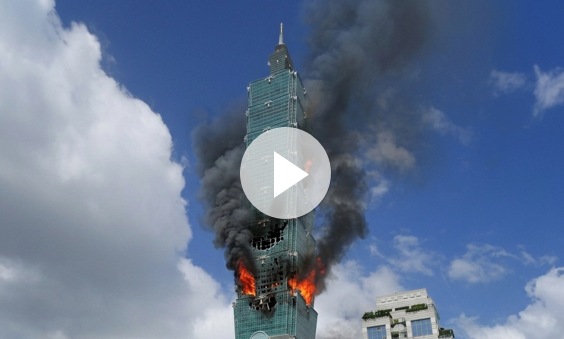
People paused mid-step on crowded sidewalks. Traffic lights reflected off the smoke that began to bloom outward, forming a dark crown around the upper floors. Sirens soon followed—not singular, but layered, multiplying across districts as if the entire emergency network had awakened at once. Some bystanders reportedly believed it was an optical illusion, a projection, even a drill. That disbelief lasted only seconds before the gravity of the moment settled in.
The first reports of casualties emerged while the flames were still climbing.
Twenty confirmed dead.
The number, stark and incomprehensible, seemed to hang in the air as heavily as the smoke itself. In a city known for precision, safety codes, and engineering pride, the unthinkable had occurred: a supertall structure had become a vertical corridor of danger.
And yet, even as emergency lights converged at the base of the tower, the upper floors remained locked in an orange-and-black silence, where glass reflected firelight like fractured mirrors of an unfolding catastrophe.
2. Overview of the Incident: A Vertical City in Crisis
According to preliminary emergency coordination briefings, the incident began shortly after nightfall when sensors within the upper mechanical floors registered abnormal heat fluctuations. Within minutes, internal alarms activated across multiple zones of the skyscraper, prompting automated shutdowns of elevator systems and the initiation of evacuation protocols.
Early reports suggest that the fire may have originated in a high-altitude technical section—an area typically reserved for communications infrastructure, ventilation systems, and structural maintenance equipment. These spaces are rarely occupied by large numbers of people, yet in supertall buildings, they are critical nodes that regulate the entire life-support system of the structure.
As the fire expanded, evacuation efforts were complicated by vertical segmentation. In skyscrapers of this magnitude, movement is not simply horizontal or vertical—it is layered, controlled by zones designed to prevent panic-induced congestion. However, in extreme conditions, those same systems can become bottlenecks.
Emergency responders faced a rapidly evolving scenario: shifting wind patterns at altitude, intermittent communication loss between floors, and the challenge of accessing upper levels where traditional firefighting ladders cannot reach.
Authorities have not yet confirmed the exact cause. Early speculation indicates possibilities ranging from electrical failure in high-load systems to overheating in energy distribution units, though investigators emphasize that no conclusion has been reached.
What is clear is that the building’s scale transformed a localized event into a multi-layered emergency operation involving fire services, structural engineers, aviation support units, and crisis psychologists.
3. Scientific and Technical Explanation: Why Fire Behaves Differently at 500 Meters
Fire in a supertall skyscraper does not behave like fire at street level. The physics changes with altitude, pressure differentials, and airflow dynamics that are amplified by height.
In structures like Taipei 101, wind loads alone can reach extraordinary speeds, and these same forces can accelerate combustion once smoke and heat escape containment zones. As hot air rises, it creates a chimney effect—an upward draft that can intensify flames by continuously feeding oxygen from lower levels while pushing heat upward.
Modern skyscrapers are engineered with compartmentalization systems designed to break this vertical airflow. Fire-resistant doors, pressurized stairwells, and automated suppression systems are meant to isolate incidents before they spread. However, in extreme scenarios involving multiple system failures or simultaneous ignition points, these defenses can be overwhelmed.
Preliminary engineering analysis suggests that if the fire did originate in a mechanical or electrical zone, the presence of high-energy cables and ventilation shafts could have created rapid heat propagation pathways. In such environments, temperatures can escalate faster than sprinkler systems can respond, particularly if smoke detectors are delayed by localized airflow disruption.
Experts also point to the phenomenon of “stack effect reversal,” where external wind pressure at high altitude can force smoke back into internal corridors rather than allowing it to vent outward. This can trap heat within evacuation routes, creating hazardous conditions even in areas far from the original ignition point.
In essence, a skyscraper fire is not a single event—it is a cascading system failure across multiple physical laws interacting simultaneously.
4. Cultural and Historical Significance: When Symbols Become Vulnerable
Taipei 101 has long stood as more than a building. Completed in the early 21st century, it was designed to symbolize resilience, innovation, and Taiwan’s emergence as a global technological hub. Its tiered design, inspired by traditional Asian architectural motifs, merges cultural heritage with cutting-edge engineering.
For years, it has represented a paradox: fragility and strength existing within the same structure. Its tuned mass damper—an enormous suspended sphere designed to counteract wind and seismic forces—has become an icon of invisible protection, a reminder that stability is often engineered through balance rather than rigidity.
A fire within such a structure therefore resonates far beyond physical damage. It challenges the cultural narrative of mastery over nature and engineering certainty. In cities across Asia, skyscrapers are not merely commercial spaces; they are national statements. When they fail, even partially, the psychological impact extends into collective identity.
Historically, skyscraper disasters have often marked turning points in urban policy and building design. Early speculation among urban historians suggests that this incident, if confirmed in detail, may prompt renewed scrutiny of high-altitude mechanical zoning and emergency evacuation logic in supertall structures worldwide.
5. Expert Analysis: Engineering Confidence Meets Uncertainty
Structural engineers observing the unfolding reports have expressed cautious concern about the interplay between redundancy systems and real-world failure cascades.
Modern skyscrapers are designed with multiple layers of safety: redundant power systems, fire-rated material segmentation, and independent ventilation controls. Yet experts suggest that redundancy does not always equate to resilience under synchronized stress.
One key issue under discussion is system coupling—the degree to which mechanical, electrical, and safety systems depend on shared infrastructure. In extreme cases, a localized failure can propagate across systems faster than isolation protocols can respond.
Fire safety specialists also emphasize human factors. Even in highly advanced buildings, evacuation speed is constrained by perception delay, communication clarity, and psychological response under stress. Panic does not scale linearly with architecture; it multiplies unpredictably.
Preliminary engineering commentary implies that the greatest vulnerability in supertall structures is not structural collapse, but cascading system confusion—where sensors, alarms, and human decision-making enter conflicting states of interpretation.
This incident, though still under investigation, may become a case study in how modern architecture must evolve beyond physical resilience into informational resilience.
6. Public Reaction and the Rise of Information Chaos
In the immediate aftermath, social media platforms became saturated with images, videos, and fragmented accounts of the event. Some footage showed flames reflecting across glass panels high above the city; others claimed multiple explosions, though these remain unverified.
As with many large-scale urban disasters, misinformation spread alongside legitimate reporting. Some posts exaggerated casualty numbers, while others suggested unrelated structural collapse scenarios. Authorities quickly urged the public to rely only on verified emergency channels.
Psychologists note that in moments of large-scale uncertainty, digital environments often mirror the chaos of physical reality. The inability to verify information in real time can amplify collective anxiety, particularly when the subject involves iconic landmarks.
Residents near the building described a mixture of shock and helplessness. Unlike earthquakes or storms, which feel external and environmental, a skyscraper fire feels architectural—an internal failure of human design. That distinction intensifies emotional response, because the threat appears both constructed and familiar.
7. Future Consequences: Rewriting the Language of Vertical Safety
If investigations confirm systemic vulnerabilities, the global architecture community may face significant revisions in how supertall buildings are designed and regulated.
Emerging discussions already point toward innovations such as autonomous fire containment zones, AI-driven predictive thermal mapping, and distributed evacuation algorithms that adapt in real time to hazard location rather than relying on fixed stairwell routes.
Some engineers propose rethinking vertical evacuation entirely, suggesting external evacuation modules or controlled descent systems integrated into building exteriors. Others argue for stricter limitations on mechanical infrastructure placement in high-altitude zones.
Insurance frameworks, urban planning regulations, and international building codes may also undergo reassessment. Historically, major structural incidents in landmark buildings have often led to decade-long shifts in global safety standards.
In this sense, the tragedy—if fully confirmed as reported—may become a catalyst for a new era of architectural intelligence, where buildings are designed not only to stand against nature, but to adapt dynamically under crisis.
8. Philosophical Reflection: The Fragility of Vertical Ambition
At its core, the image of a burning skyscraper is more than an engineering failure; it is a confrontation with human ambition itself. Cities build upward to defy limitation, to compress density into vertical expression, to transform land into sky.
Yet height introduces a paradox: the higher humanity climbs, the more complex its vulnerabilities become. Each additional floor is not just space—it is an added layer of dependency on invisible systems: pumps, sensors, algorithms, airflow controls, and electrical grids.
The fire at Taipei 101, whether understood as a literal event or examined as a cautionary narrative, reflects a deeper truth about modern civilization: that progress is not linear strength, but increasingly delicate interdependence.
In the end, skyscrapers are not simply structures of steel and glass. They are philosophies made visible—statements about control, order, and aspiration. When they burn, they remind us that even the most advanced systems are still bound by elemental forces older than architecture itself.
And somewhere in the reflection of that fire against the night sky, there remains a quiet question—one that cities rarely answer directly: how high is too high, when the ground is always waiting below?