
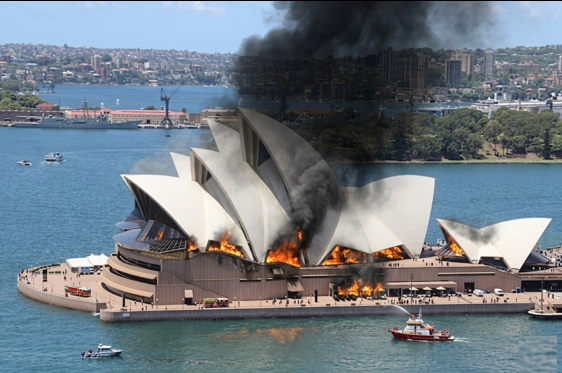
Fire Beneath the Sails: The Night the Sydney Opera House Burned
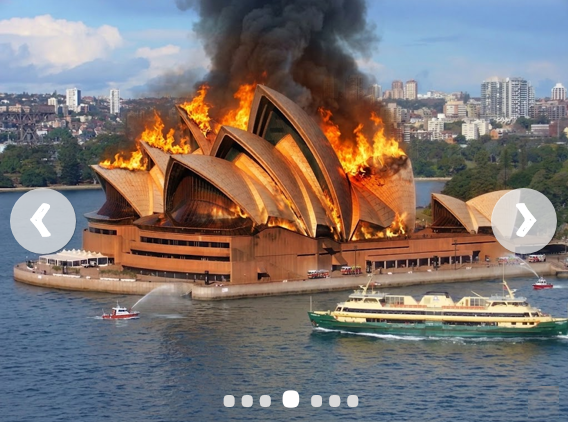
The first sign was not flame, but light.
At 8:17 p.m., as twilight settled over Sydney Harbour in ribbons of indigo and molten orange, tourists standing near Circular Quay noticed a strange flicker beneath the iconic white shells of the Sydney Opera House. At first it looked theatrical, almost intentional — a reflection from stage lighting or a rehearsal effect leaking through backstage vents. Ferries crossed the harbor with their usual rhythm, cameras flashed against the skyline, and diners along the waterfront continued sipping wine beneath warm autumn air.
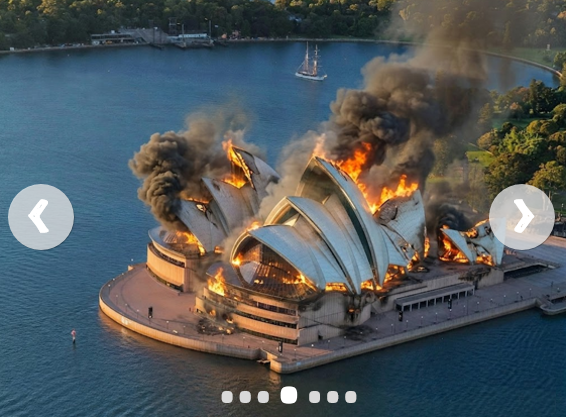
Then came the smoke.
Dark, oily plumes began curling upward between the soaring concrete sails, swallowing the fading evening sky. Within minutes, the glow intensified into violent orange bursts visible from kilometers away. Witnesses described hearing alarms echoing through the concourse followed by a sharp cracking sound “like timber exploding under pressure.” Some thought it was part of a performance. Others froze in disbelief, unable to reconcile the sight before them: one of the most recognizable buildings on Earth appearing to burn from within.
People began running.
Crowds spilled onto the promenade in panic as emergency announcements fought against confusion and noise. Musicians still in costume emerged carrying instruments. Audience members stumbled through smoke-filled corridors illuminated only by emergency strips and flashing exit signs. Some were crying. Some were filming. Others stood transfixed, staring at the impossible image of flames licking across the understructure of a monument that had long seemed untouchable — a cathedral of modern civilization now transformed into a furnace.
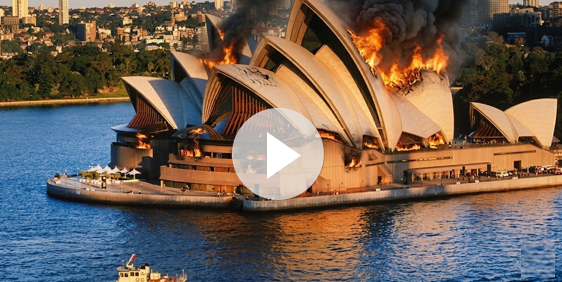
By midnight, preliminary reports indicated that at least 20 people had died and more than 50 had been rescued from various sections of the complex, including rehearsal rooms, service corridors, elevated catwalks, and underground utility spaces. Rescue crews continued searching through smoke and debris as helicopters circled overhead, broadcasting images that would rapidly travel across every major network and social media platform in the world.
The Sydney Opera House — symbol of Australia, masterpiece of modern engineering, and one of humanity’s most celebrated cultural landmarks — had become the center of a catastrophe unfolding in real time.
And as the flames rose over Sydney Harbour, the world watched in collective horror.
A Monument Turned Into a Labyrinth of Smoke
Emergency responders arriving at the scene reportedly faced immediate and severe complications. The Opera House, despite its global familiarity, is internally a highly complex structure: a maze of interconnected performance halls, mechanical systems, service tunnels, suspended ceilings, electrical infrastructure, and acoustically engineered chambers. Firefighters entering the building encountered rapidly deteriorating visibility, intense heat pockets, and confusing smoke migration patterns that appeared to spread unpredictably through concealed spaces.
Experts suggest that large cultural venues such as the Opera House present uniquely difficult firefighting conditions because they combine public occupancy, historical preservation requirements, and highly specialized architecture. The very design features that make these structures acoustically magnificent can also create dangerous pathways for smoke and heat transfer.
According to early witness testimony, several occupants became trapped after smoke filled stairwells and backstage routes faster than expected. Preliminary reports imply that some interior evacuation systems may have been compromised by the speed of the blaze or by failures within localized power networks.
For survivors, the experience was described less as a fire than as a disorienting collapse of reality.
One concert attendee reportedly recounted hearing musicians continue playing for several seconds after alarms activated, uncertain whether the interruption was technical or genuine. Another described “walking into blackness” where the smoke became so dense that breathing felt impossible within moments. Emergency responders allegedly used thermal imaging equipment to locate unconscious victims in confined areas where visibility had dropped to nearly zero.
Outside, the harbor transformed into an eerie theater of emergency response. Ferries were redirected to assist evacuations. Police established expanding exclusion zones. Medical triage stations appeared along the waterfront under portable floodlights while smoke drifted across the skyline like storm clouds.
The image of the burning structure quickly became global shorthand for vulnerability in an age increasingly defined by cascading crises.
Because this was not merely a building.
It was the Sydney Opera House.
The Engineering Marvel That Redefined Architecture
Completed in 1973 after years of controversy, delay, and political conflict, the Sydney Opera House has long stood as one of the defining achievements of twentieth-century engineering. Designed by Danish architect Jørn Utzon, the structure revolutionized architectural thinking with its sweeping shell-like roof geometry — forms so ambitious that engineers initially struggled to determine how to build them at all.
The building’s iconic “sails” are not actually sails, but complex precast concrete shells assembled from thousands of individual segments. Beneath the sculptural exterior lies an extraordinarily intricate internal support system designed decades before modern computational modeling existed. In many ways, the Opera House was born at the frontier between artistic imagination and engineering impossibility.
That complexity may now become central to understanding the disaster.
Fire behavior inside monumental structures differs dramatically from ordinary residential or commercial fires. In large performance venues, heat can travel invisibly through ventilation systems, cable ducts, ceiling voids, and structural cavities. Acoustic insulation materials, stage rigging, electrical networks, and older retrofit systems can create unpredictable ignition pathways.
Experts in structural fire engineering suggest that modern landmark buildings often contain layers of infrastructure accumulated over decades of renovations and technological upgrades. Even when fire systems comply with regulations, hidden vulnerabilities can emerge from interactions between aging components and contemporary demands.
Preliminary speculation indicates investigators may examine whether the blaze originated in backstage mechanical infrastructure, electrical systems, or technical staging areas. However, officials have not confirmed a cause, and investigators are expected to conduct extensive forensic analysis before definitive conclusions emerge.
What remains undeniable is the extraordinary challenge of defending a structure that was never originally conceived for the fire risks of the twenty-first century.
Modern performance venues rely on massive electrical loads: digital lighting arrays, climate systems, audiovisual equipment, communications infrastructure, and computer-controlled staging machinery. The energy demands placed upon heritage landmarks today often vastly exceed what architects of earlier generations envisioned.
And when fire enters such systems, it can spread with terrifying speed.
The Psychological Shock of Watching an Icon Burn
Disasters involving symbolic structures trigger a peculiar form of collective trauma.
Psychologists sometimes refer to these moments as “identity shocks” — events in which physical destruction destabilizes emotional assumptions about permanence, safety, and continuity. The Sydney Opera House occupies a rare category of global landmarks whose imagery transcends geography. Like the Eiffel Tower, the Statue of Liberty, or the Taj Mahal, it exists not merely as architecture but as psychological territory shared by millions who may never physically visit it.
Its destruction, even partial, feels personal to people far beyond Australia.
Within minutes of the first broadcasts, social media platforms flooded with reactions ranging from grief to disbelief to conspiracy speculation. Hashtags spread globally. Some users falsely claimed the structure had entirely collapsed. Others circulated outdated photographs or fabricated videos generated through artificial intelligence tools. Emergency officials reportedly struggled to counter waves of misinformation while simultaneously managing an unfolding rescue operation.
This pattern has become characteristic of modern catastrophe.
The digital era compresses tragedy into instantaneous spectacle. Viewers around the world consume disasters not gradually through newspapers or scheduled broadcasts but through fragmented streams of panic, rumor, livestream footage, and algorithmic amplification. Emotional reactions spread faster than verified information.
Experts in crisis communication warn that misinformation during emergencies can actively endanger lives by interfering with evacuation guidance, overwhelming emergency channels, or provoking unnecessary panic. In recent years, emergency management agencies globally have increasingly integrated social media monitoring teams specifically to combat false narratives during unfolding disasters.
Yet the emotional velocity of iconic destruction is difficult to contain.
Many Australians reportedly gathered silently across the harbor overnight simply to watch. Some sang. Others wept openly. The illuminated skyline of Sydney — usually associated with celebration, tourism, and national identity — had transformed into a scene of mourning.
For older residents, the event revived memories of earlier national traumas: bushfires, floods, terrorist anxieties, and environmental disasters. For younger generations raised in a digital world saturated with instability, the fire became another reminder that even humanity’s most revered achievements are fragile.
Civilization, the images seemed to say, burns too.
Fire, Acoustics, and the Hidden Science of Catastrophe
Large performance halls are engineered around one obsession: sound.
Every surface inside venues like the Sydney Opera House is carefully designed to manipulate acoustic reflection, resonance, absorption, and reverberation. Walls curve to direct orchestral frequencies. Timber panels diffuse echoes. Cavities and chambers shape tonal warmth. Even seat materials influence sonic behavior.
Ironically, some of these same design characteristics can complicate fire dynamics.
Smoke movement in massive auditoriums behaves differently from smoke in conventional buildings. Heat stratification, pressure differentials, and ventilation interactions can produce rapidly shifting layers of toxic gases. In enclosed theatrical spaces, superheated smoke may accumulate near ceilings before descending suddenly in deadly waves known as “smoke rollback.”
Fire scientists note that modern fires are often more lethal because synthetic materials produce highly toxic combustion products, including carbon monoxide and hydrogen cyanide. Victims frequently succumb not to burns, but to inhalation injuries occurring within minutes.
Preliminary rescue accounts suggest some survivors experienced severe respiratory distress even in areas physically distant from visible flames. This aligns with known behavior in enclosed venue fires where smoke propagation can outpace occupant awareness.
Investigators will likely analyze whether compartmentation systems — architectural features designed to contain smoke and fire within isolated zones — functioned effectively during the incident. Experts may also examine sprinkler deployment patterns, emergency ventilation responses, and evacuation timing relative to smoke spread.
These technical details matter not merely for assigning blame but for the future survival of cultural infrastructure globally.
Because the Opera House fire may become a warning.
Around the world, countless historic venues operate under mounting pressure from climate stress, aging infrastructure, increased tourism, technological retrofits, and escalating energy demands. As heatwaves intensify and urban electrical systems face growing strain, fire risk in complex public buildings may rise correspondingly.
The tragedy unfolding in Sydney could therefore reshape international standards for cultural landmark safety.
The Cultural Heart of a Nation Under Threat
To understand the emotional magnitude of the disaster, one must understand what the Opera House represents.
Since its opening by Queen Elizabeth II in 1973, the building has become inseparable from Australia’s image to the world. It appears in Olympic broadcasts, tourism campaigns, diplomatic events, films, and national celebrations. More than architecture, it functions as a civic altar — a place where art, politics, identity, and international perception converge.
Its stages have hosted opera legends, Indigenous performances, state ceremonies, experimental theater, political protests, and global music icons. Millions have walked its promenades. Millions more know Australia primarily through its silhouette against Sydney Harbour.
The idea that such a place could become a disaster zone carries profound symbolic weight.
Cultural historians often note that attacks, accidents, or catastrophes involving iconic buildings produce deeper emotional reverberations because societies unconsciously project permanence onto monuments. We expect them to outlive us. When they fail, something inside collective memory fractures.
This explains why footage of smoke pouring through the Opera House resonated far beyond conventional news coverage. The images carried mythic power. They suggested vulnerability not only of a building but of continuity itself.
Art institutions worldwide reportedly began reviewing emergency procedures almost immediately following the incident. Several major cultural venues issued statements of solidarity while quietly initiating internal safety reassessments.
Because beneath the grief lies fear.
If the Sydney Opera House can burn, what cannot?
The Long Shadow of Recovery
Even after flames are extinguished, catastrophic fires continue unfolding for years.
Structural engineers will now face the immense challenge of determining whether portions of the Opera House remain salvageable. Fire weakens concrete, warps steel, damages acoustic systems, destroys electrical infrastructure, and contaminates interiors with corrosive soot and toxic residues. Water used during suppression efforts can trigger secondary destruction through mold, chemical reactions, and material degradation.
Restoration, if possible, could take years.
Experts suggest rebuilding efforts would involve not only engineering complexity but philosophical debate. How much of a cultural landmark can be replaced before authenticity itself becomes compromised? Should restoration prioritize historical accuracy or modern resilience? Would future renovations transform the building into something fundamentally different?
These questions echo previous global restoration controversies following fires at historic sites such as Notre-Dame Cathedral in Paris. Reconstruction is never purely technical. It becomes cultural negotiation — an argument about memory, identity, and the meaning of preservation.
Financial implications may also prove enormous. Preliminary speculation indicates damages could potentially reach into the billions depending on structural impact, restoration scope, operational disruption, and long-term tourism losses.
Yet economic calculations alone cannot measure what has been affected.
For performers, the Opera House is sacred terrain. For Australians, it is emotional geography. For the world, it is a symbol of creative ambition made concrete.
And symbols are difficult to rebuild once wounded.
A World Watching Itself Burn
There is a reason images of monumental fires haunt civilizations across centuries.
From the burning Library of Alexandria to the destruction of cathedrals during war, fire occupies a uniquely terrifying place in human imagination because it represents both annihilation and revelation. Flames erase, but they also expose weaknesses hidden beneath surfaces we assumed were eternal.
The Sydney Opera House fire arrives at a historical moment already saturated with anxiety. Climate disasters intensify globally. Urban systems strain under technological complexity. Public trust in institutions fractures under misinformation and polarization. Infrastructure once considered permanent increasingly appears vulnerable to cascading failures.
In that context, the blaze becomes more than an isolated event.
It becomes metaphor.
The sight of smoke rising through one of humanity’s most celebrated cultural structures evokes unsettling questions about modern civilization itself. We have built dazzling cities, astonishing technologies, and globally interconnected societies — yet many of these systems remain precariously fragile beneath their polished surfaces.
Experts may eventually determine the precise cause of the fire. Investigators will produce reports. Engineers will debate materials and safety systems. Governments will commission inquiries. Reconstruction plans may emerge.
But long after those processes conclude, another image will remain lodged in public consciousness:
The white sails of the Sydney Opera House glowing orange against the night sky while thousands watched in stunned silence from the harbor below.
An architectural masterpiece built to celebrate human creativity suddenly illuminated by destruction.
A reminder that civilization’s greatest achievements are not immune to chaos.
And perhaps, too, a reminder of why humanity keeps building them anyway.